
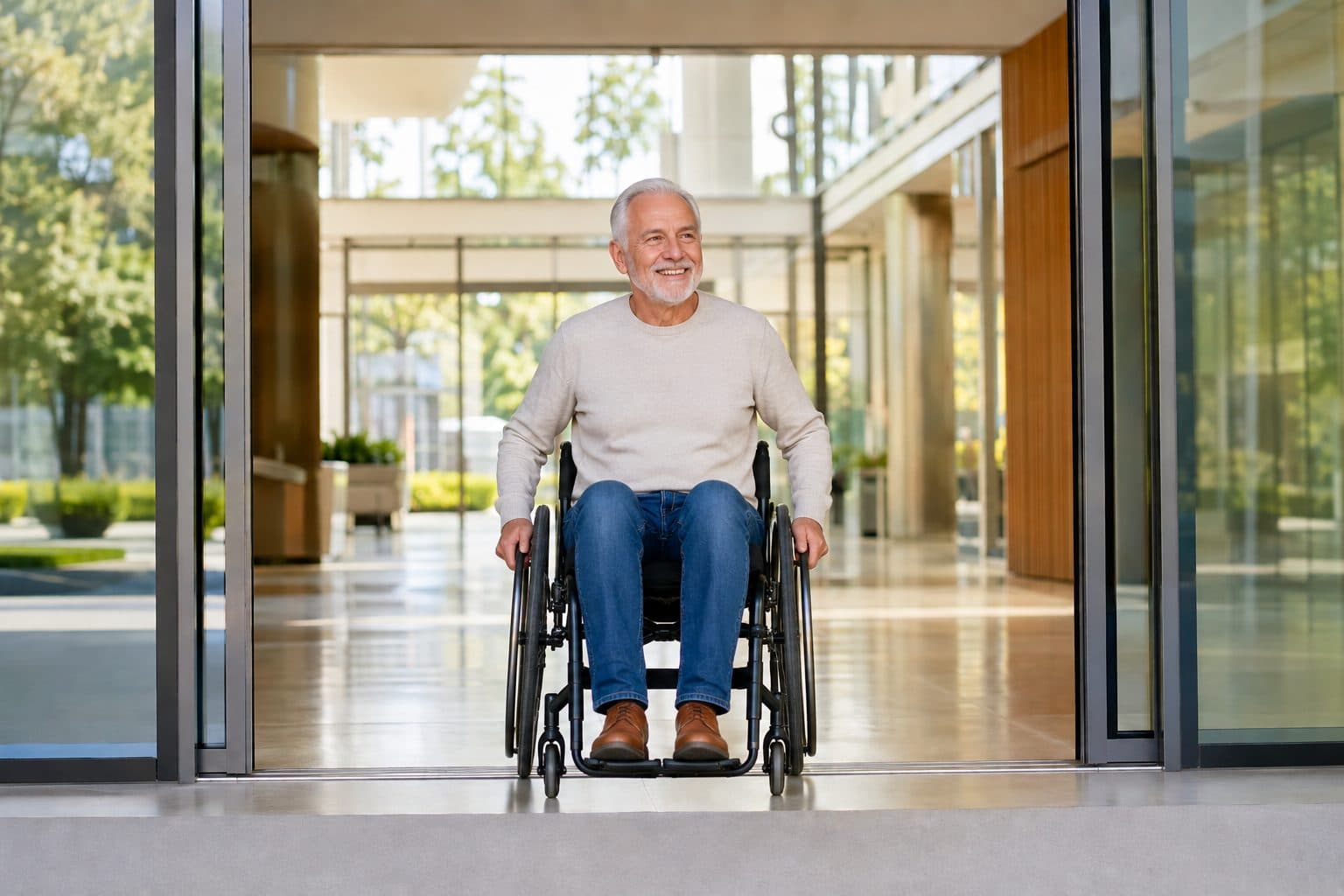
For retirement villages
Doors that let residents keep their independence.
In a village, a door that's hard to open doesn't just slow someone down — it quietly shrinks where they're willing to go.
A brand of FAAC Technologies
Residents who need a hand with a door usually stop using it. The garden, the communal lounge, the route to the dining room — each heavy door is a decision point, and over time people take fewer of them. Automating those doors is one of the cheapest interventions available for keeping a village genuinely usable by everybody in it.
The operator settings matter as much as the operator. Doors on resident routes should open gently, hold open long enough for someone using a walker to clear the opening comfortably, and never close faster than the slowest person likely to use them. That's a commissioning decision, and we set it deliberately.
Villages also run continuously, which means entrances accumulate cycles fast. Planned servicing keeps opening forces and detection fields inside tolerance, which is both a safety matter and the reason doors don't fail on a Sunday.
What matters to you
- Low-energy operation
- Gentle opening and generous hold-open times set for residents using frames, walkers and wheelchairs.
- Retrofit to existing doors
- Most village doors can be automated in place, without rebuilding the doorway or disrupting residents.
- Safe detection
- Presence sensing tuned so a door will not close on someone moving slowly through the opening.
- Servicing that keeps up
- Scheduled maintenance sized to the traffic, so entrances stay reliable across a village's whole door population.


Retirement Villages
How many doors, and where?
Tell us roughly how many entrances the village has and which ones cause trouble — we'll come and look.
Auckland & Christchurch — servicing nationwide